Residency by investment in Indonesia
Indonesia Golden Visa and Second Home Visa in 2026
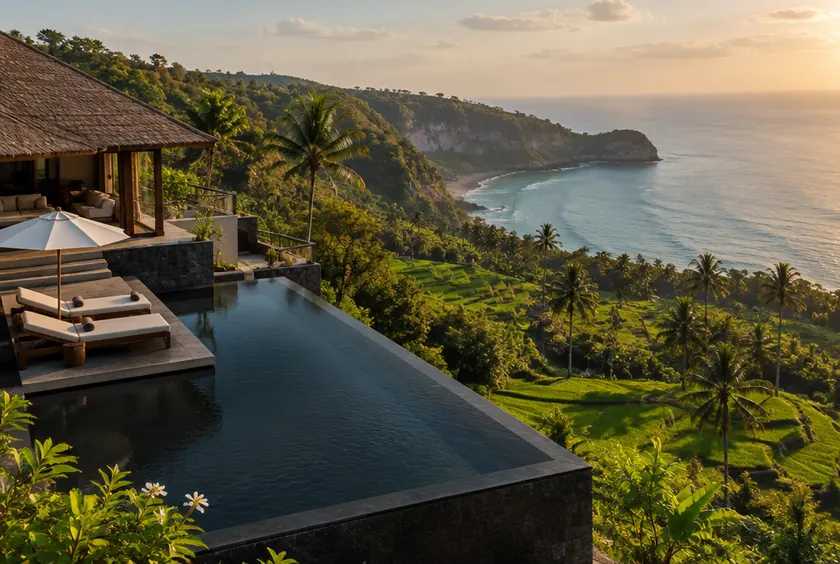
Indonesia sells long-term residency three different ways, and most pages about the "Indonesia Golden Visa" quietly mix them up. The Golden Visa proper is the E28 investor series from the 2023 immigration regulation: five or ten years of residence against an investment that starts at US$350,000 in Indonesian government bonds, listed shares or mutual funds. The Second Home Visa (E33) is the budget sibling: five years of residence against roughly US$130,000 parked in your own account at an Indonesian state bank. And the Investor KITAS (E28A) is the working option for people who actually run an Indonesian company.
This page keeps the three apart, gives the government's own fee numbers in rupiah, and is blunt about the two things the brochures skip: the 90-day proof-of-funds deadline, and the fact that none of these routes leads to an Indonesian passport, because Indonesia does not allow dual citizenship. Figures checked against the Directorate General of Immigration's published material as of 23 October 2026; your case is confirmed before any fee.
What Indonesia actually offers
Indonesia introduced its Golden Visa by regulation in mid-2023 and launched it fully in July 2024. By the government's own count it had issued well over a thousand of these permits within two years. All of the routes below end in the same kind of document: an ITAS, a limited-stay permit, electronically issued, with multiple re-entry built in and no sponsor or local employer required.
What differs is the money, the term, and what you are allowed to do:
- Golden Visa, E28C: for individual investors who do not want to run a company. US$350,000 placed in Indonesian government bonds, shares of listed companies, or mutual funds buys a 5-year permit; US$700,000 buys a 10-year permit.
- Golden Visa, E28B: for investors who establish an Indonesian company, with commitments from US$2,500,000 for 5 years or US$5,000,000 for 10 years.
- Second Home Visa, E33: five years of residence against proof of funds of about US$130,000, equivalent to roughly Rp 2 billion, deposited in your own name at a state-owned bank, or ownership of property worth US$1,000,000 or more under a title foreigners can legally hold.
- Investor KITAS, E28A: the older, cheaper working route, for shareholders holding at least Rp 10 billion of shares in their own Indonesian PT PMA company. One to two years at a time, renewable, and it permits working in your own company.
If your goal is simply to live in Bali, Jakarta or Lombok for years at a time without visa runs, the Second Home Visa is usually the honest starting point. The E28C Golden Visa makes sense when the budget is there and you want the 10-year horizon or the priority treatment that comes with investor status.
All routes in one table
Amounts are the government's published thresholds as of 23 October 2026. Where the official figure is set in US dollars, we quote dollars; where it is set in rupiah, we quote rupiah.
| Route | Investment | Term | What you may do |
|---|---|---|---|
| Golden Visa E28C (individual investor) | US$350,000 for 5 years; US$700,000 for 10 years, in government bonds, listed shares or mutual funds | 5 or 10 years | Live in Indonesia, no sponsor, multiple re-entry, priority immigration lanes. Not a work permit for local employment. |
| Golden Visa E28B (establish a company) | US$2,500,000 for 5 years; US$5,000,000 for 10 years, invested through a new Indonesian company | 5 or 10 years | Run the company you establish, plus everything E28C grants. |
| Second Home Visa E33 | About US$130,000 (roughly Rp 2 billion) deposited at a state-owned bank, or US$1,000,000+ in qualifying property | 5 years, extendable | Live in Indonesia with your family. Local employment is not permitted; the deposit stays yours and earns interest. |
| Investor KITAS E28A | At least Rp 10 billion in shares of your own PT PMA, held in your name | 1 to 2 years, renewable | Work as a director or commissioner in your own company without a separate work permit. |
Prefer to just ask? Send your citizenship and budget on WhatsApp and a person replies, usually within an hour.
Book a 20-min consultationThe Second Home Visa in detail
The Second Home Visa is the route most people who ask us about "the Indonesia golden visa" actually end up choosing, because the money is not spent and not locked into securities: it sits in your own account.
How it works in practice:
- You apply online through the official eVisa portal, with a written commitment to meet the financial requirement.
- The visa is approved and you enter Indonesia.
- Within 90 days of arrival you place the funds, about US$130,000 or the rupiah equivalent of roughly Rp 2 billion, in an account in your own name at a state-owned bank: Bank Mandiri, BNI, BRI or BTN. Property worth US$1,000,000 or more under a Hak Pakai (right-to-use) title is the published alternative.
- The balance must stay at that level for as long as you hold the visa. Immigration can check it. Miss the 90-day deadline or draw the account down, and the permit can be cancelled.
The deposit earns normal bank interest and is returned to you in full when you give up the visa. There is no sponsor, no age limit, and approval normally takes a few weeks once the file is complete.
Two honest limits. First, this is not a work permit: local employment and Indonesian-source employment income are off the table, though working remotely for a foreign employer is commonly done. Second, the property alternative is narrower than agents imply: the US$1,000,000 must be property a foreigner can legally hold, which in Indonesia means Hak Pakai apartments or similar, never the freehold land titles reserved for Indonesian citizens, and never a leasehold villa contract.
The E28C investor route in detail
E28C is the Golden Visa for individual investors who do not want to establish or run a company. The qualifying instruments are set by the regulation:
- Indonesian government bonds,
- shares of companies listed on the Indonesia Stock Exchange, or
- Indonesian mutual funds.
US$350,000 across these instruments qualifies you for the 5-year permit; US$700,000 for the 10-year permit. Published guidance has also listed residential property worth US$1,000,000 or more, for example an apartment, as a 10-year qualifier; because practice on the property variant has been less consistent than on the securities variant, we treat it as a case to confirm with immigration before you commit.
As with the Second Home Visa, the investment is placed after approval, within 90 days, and held for the life of the permit. Unlike a Caribbean citizenship donation, the money remains your asset: bonds pay coupons, deposits pay interest, and you take it all back if you later leave the scheme.
Holders get the practical perks Indonesia advertises for Golden Visa status: longer terms, priority lanes at major airports, and no need for a local sponsor at any point. If you intend to be a hands-on owner of an Indonesian business instead, compare the E28A Investor KITAS first: at Rp 10 billion in shares it is a fraction of the E28B commitment and it is the one that lets you actually work in the company.
What it costs: government fees in rupiah
Indonesia publishes immigration fees (PNBP) in rupiah on the official eVisa portal. The widely published rates for these visa classes as of October 2026 are below; the portal shows the binding figure for your application, and we re-check it before any filing.
| Item | Amount | Note |
|---|---|---|
| Golden Visa, 5-year (E28 series) | Rp 13,000,000 (about US$800) | Visa and limited-stay permit fee, per applicant, paid online at application. |
| Golden Visa, 10-year (E28 series) | Rp 19,500,000 (about US$1,200) | Per applicant. |
| Second Home Visa, 5-year (E33) | Rp 13,000,000 (about US$800) | Per applicant; dependent family permits are charged separately at lower rates. |
| The investment itself | US$130,000 to US$700,000 depending on route | Not a fee: deposits and securities remain your property and are returned or sold when you exit. |
| Our advisory fee | Quoted in writing before you pay anything | Covers route selection, the file, the bank introduction and the eVisa filing. No percentage of your investment. |
How the application runs
The whole process is online-first, which makes Indonesia one of the most straightforward files on this site.
- Route check. Citizenship, budget, family, and what you actually want to do in Indonesia. This is where E28C versus Second Home versus Investor KITAS gets decided, and it takes one conversation.
- eVisa application. Filed on the official portal, evisa.imigrasi.go.id, with passport scans, a photograph, a short CV, proof of living costs (a bank statement that has not dipped below US$2,000 over the last three months is the published benchmark for the Second Home route), and the written commitment to invest.
- Approval and entry. The electronic visa normally issues within days to a few weeks. You enter Indonesia on it.
- Funding within 90 days. The deposit is placed or the securities are bought. For the Second Home route this means opening the state-bank account, which is the step where an introduction and a prepared document set save the most time.
- ITAS and biometrics. The limited-stay permit is issued electronically; biometrics are completed in Indonesia. After three years of continuous residence you may apply for a KITAP, the permanent-stay permit.
No interview, no quota, no nationality bans of the Caribbean kind. The failure modes are mundane: a passport with too little validity, a bank statement that dips, or the 90-day funding deadline treated casually.
Timeline: what takes how long
Quoted end-to-end times for Indonesia are short compared with anything European on this site, and for once the short quotes are honest:
- eVisa approval: typically days to a few weeks from a complete online file.
- Funding window: up to 90 days after arrival, at your own pace.
- ITAS issuance: electronic, following the visa; biometrics are booked in-country.
- KITAP (permanent stay): available after 3 years of continuous residence on these permits.
What actually delays an Indonesia file:
- Opening the state-bank account without local help, especially where the bank branch rarely handles foreign Second Home clients
- Passports with under 36 months of validity, which several of these visa classes expect
- Marriage and birth certificates for dependants that still need apostille and certified translation
- Trying to qualify with property that a foreigner cannot legally hold, which restarts the route decision from zero
Taxes and rules worth knowing before you move
None of this is tax advice, but three published rules decide most planning conversations, so they belong on the page.
Tax residency at 183 days. Spend more than 183 days in Indonesia in a 12-month period, or make it your place of domicile, and you are an Indonesian tax resident under Indonesian law. Indonesia taxes residents on worldwide income, with treaty relief where a treaty exists. Plenty of Second Home holders structure their year around this; the ones who regret it are the ones who never checked.
No dual citizenship. Indonesian law does not permit adults to hold two citizenships, and naturalisation as an Indonesian requires renouncing your current passport. So unlike Portugal, the Indonesian residency routes are not a back door to a second passport, and we will not sell them to you as one. They are long-term residency, done properly.
Foreign land ownership. Foreigners cannot own freehold land (Hak Milik) in Indonesia. The property variants of these visas work through Hak Pakai (right-to-use) titles on apartments and houses in designated categories. A 25-year Bali villa lease, whatever the agent says, is not visa-qualifying property.
One more practical note: holders of these permits are expected to keep a local address registered and to report changes; the permits are electronically tied to your passport, so a passport renewal means a permit transfer, a routine filing we handle as part of the file.
Requirements checklist
The published list for the Second Home and E28C routes is short. A complete file contains:
- A passport, ideally with 36 months or more of validity remaining
- A recent colour photograph and a short CV
- Proof of living costs: a personal bank statement that has stayed above US$2,000 over the last three months
- The written commitment to place the qualifying deposit or investment within 90 days of arrival
- After arrival: the state-bank deposit of about US$130,000 (Second Home), or the securities purchase of US$350,000 or more (E28C)
- An Indonesian address for registration
- For family members: marriage and birth certificates, apostilled and translated where required
- Government fee payment online, in rupiah, at the published PNBP rate
Family: who can come with you
Both the Golden Visa and the Second Home Visa carry family provisions that are more generous than most European programs:
- Spouse, on a dependent permit matching your term
- Children, up to 18, or up to 25 where they are unmarried students
- Parents, also eligible as dependants
Dependants do not need their own deposit or investment; they ride on the principal's qualification, with their own (smaller) permit fees. Dependants face the same no-local-work rule as the principal on the Second Home route. Children in international schools in Bali or Jakarta are the normal case this is built for, and school enrolment letters slot straight into the dependant file.
Who this fits, and who it does not
Indonesia fits three profiles unusually well.
The long-stay family. If the actual goal is years in Bali or Jakarta, schooling, surf, remote work on a foreign payroll, the Second Home Visa at about US$130,000 in your own bank account is the cheapest credible long-term residency on this entire site, and the money never leaves your name. Compare that honestly with a Caribbean donation of US$200,000+ that is spent, for a passport you may not need.
The investor who wants Asia optionality. E28C at US$350,000 in government bonds pays coupons while it qualifies you, and the 10-year tier at US$700,000 is one of the longest single permits available anywhere.
The owner-operator. Anyone genuinely running an Indonesian business belongs on the E28A Investor KITAS at Rp 10 billion in shares, not on a Golden Visa twice the price that still does not permit employment.
Who it does not fit: anyone whose real goal is a second passport or visa-free travel on a new nationality. Indonesia's dual-citizenship ban closes that door, and a Caribbean citizenship program or the Portugal fund route is the honest answer instead. If you are an Indonesian citizen looking outward rather than a foreigner looking in, your page is golden visas for Indonesian citizens.
Indonesia vs UAE vs Portugal: one table
These are the three residency-by-investment programs clients most often weigh against each other on this desk. Same format, same honesty, three very different products.
| Indonesia (E28C / Second Home) | UAE Golden Visa | Portugal Golden Visa | |
|---|---|---|---|
| Minimum investment | US$130,000 bank deposit (Second Home) or US$350,000 in bonds/funds (E28C) | AED 2,000,000 property, about US$545,000 | €500,000 regulated fund |
| Is the money spent? | No: deposit or securities stay yours and earn interest or coupons | No: you own the property | No, but locked in a fund for 5+ years with market risk |
| Permit term | 5 years (Second Home) or 5-10 years (E28C), then KITAP after 3 years' residence | 10 years, renewable | Renewable 2-year cards while the investment is held |
| Path to citizenship | Effectively none: Indonesia bans dual citizenship | None in the ordinary sense: naturalisation is invitation-only | Yes: 10 years' lawful residence for most nationalities, after the May 2026 law change |
| Minimum stay to keep it | None published; KITAP and tax planning set the real calendar | None in practice | About 7 days a year for the permit; citizenship needs real residence |
| Government fees | Rp 13,000,000 to Rp 19,500,000 per applicant (US$800-1,200) | About 4% property transfer fee plus roughly AED 10,000 in permit services | About €843 filing plus about €8,419 issuance per person; 25% less online |
| Family | Spouse, children to 18 (25 if studying), parents | Spouse, children, parents under conditions | Spouse, dependent children, dependent parents |
| Typical speed to permit | Weeks | Weeks to a few months | A year or more at current AIMA workloads |
Official sources and how to read this page
Primary sources: the Directorate General of Immigration (imigrasi.go.id) and its eVisa portal (evisa.imigrasi.go.id), where the binding fee and requirement for each visa class is published; the 2023 immigration ministerial regulation that created the Golden Visa and Second Home classes; and Indonesian state-bank deposit documentation for the Second Home route. Dollar conversions are approximate at October 2026 rates.
Figures last checked on 23 October 2026. Thresholds and fees here have already changed more than once since 2023, and secondary sites still quote superseded numbers; where published sources conflict, we flag it above rather than pick the prettiest figure. Not legal or tax advice: your route, fees and timing are confirmed against the portal and with the professionals on your file before you commit anything.
Book a 20-min consultation
Three answers are enough. The button opens WhatsApp with a short ready-made message; a person reads it and replies, usually within an hour. No documents needed for the first call.
WhatsAppIndonesia Golden Visa: frequently asked questions
How much does the Indonesia Golden Visa cost in 2026?
The E28C route for individual investors requires US$350,000 in Indonesian government bonds, listed shares or mutual funds for a 5-year permit, or US$700,000 for 10 years. The government fee is around Rp 13,000,000 (about US$800) for 5 years or Rp 19,500,000 (about US$1,200) for 10 years. The investment is not spent: it remains your asset.
What is the difference between the Golden Visa and the Second Home Visa?
The Golden Visa (E28 series) is for investors and starts at US$350,000 in securities, with 5 and 10-year terms and investor perks like priority airport lanes. The Second Home Visa (E33) is the budget route: about US$130,000 deposited in your own account at a state-owned bank buys 5 years of residence. Both lead to permanent residence (KITAP) after 3 years; neither permits local employment.
How much money do I need for the Indonesia Second Home Visa?
Proof of funds of about US$130,000, equivalent to roughly Rp 2 billion, placed in an account in your own name at a state-owned Indonesian bank (Mandiri, BNI, BRI or BTN) within 90 days of arrival. The published alternative is ownership of property worth US$1,000,000 or more under a title foreigners can hold. The balance must be maintained while you hold the visa.
Does the Indonesia Golden Visa lead to citizenship?
Effectively no, and anyone selling it as a passport route is misleading you. Indonesian law does not permit dual citizenship for adults, so naturalising would require renouncing your current nationality. These are long-term residency products. If a second passport is the actual goal, a Caribbean citizenship program or Portugal's route is the honest comparison.
Can I buy a villa in Bali to qualify?
Almost never in the way agents suggest. Foreigners cannot own freehold land in Indonesia, and a leasehold villa contract is not visa-qualifying property. The property variants require US$1,000,000 or more under a Hak Pakai (right-to-use) title, which in practice means specific apartments and houses in designated categories. The bank-deposit route is simpler and far more predictable.
What is the 90-day rule?
Your visa is approved on a written commitment to invest. From the day you arrive in Indonesia you have 90 days to actually place the deposit or buy the qualifying securities. Immigration can and does check. Missing the deadline risks cancellation of the permit, so we schedule the bank appointment before the flight, not after.
Which banks qualify for the Second Home deposit?
State-owned banks: Bank Mandiri, BNI, BRI and BTN are the named options. The account must be in your own name, and the roughly US$130,000 balance must stay at that level while the visa is valid. The deposit earns normal interest and is returned in full when you exit the scheme.
How long does the Indonesia Golden Visa take to get?
It is one of the fastest files on this site. The eVisa application is online and typically approves within days to a few weeks when complete. The limited-stay permit (ITAS) issues electronically after entry, with biometrics completed in Indonesia. The slow steps are usually document legalisation for family members and the bank account opening.
Can I work in Indonesia on these visas?
Not in local employment. The Second Home Visa and the E28C investor route do not permit working for an Indonesian employer or earning Indonesian-source employment income; remote work for a foreign employer is commonly done. If you want to run your own Indonesian company, the E28A Investor KITAS (Rp 10 billion in shares of your own PT PMA) or the E28B Golden Visa are the routes that permit it.
Can my family join me?
Yes: spouse, children up to 18 (or up to 25 if unmarried students) and parents can join as dependants on permits matching your term. They do not need their own deposit or investment, only their own smaller permit fees and legalised civil documents.
Will I have to pay Indonesian tax?
If you spend more than 183 days in Indonesia in a 12-month period, or make it your domicile, you become an Indonesian tax resident, taxed on worldwide income with treaty relief where a treaty applies. Many holders plan their calendar around this. Get specific tax advice before you move, not after: we can introduce a tax professional alongside the visa file.
What happens to my deposit if I give up the visa?
It is returned to you. The Second Home deposit and the E28C securities are your property throughout: they earn interest or coupons while qualifying you, and when you leave the scheme you withdraw or sell them. This is the biggest practical difference from Caribbean citizenship donations, which are spent.
What is a KITAP and when can I get one?
KITAP is Indonesia's permanent-stay permit. After 3 years of continuous residence on a Second Home or investor permit you may apply, which removes the need to re-qualify and loosens the tie to the deposit. It is the natural end-state for people who genuinely settle.
Is there a retirement visa instead?
Yes. Indonesia runs separate retirement permits for applicants aged 55 and over, with much lower financial requirements than the Second Home Visa but tighter conditions. If you are over 55 and the goal is simply living in Bali, ask us to compare the two before you commit US$130,000: sometimes the retirement route is the better answer.
How long must my passport be valid?
Plan on at least 36 months of remaining validity for these long-term visa classes; some summaries say less, but a long permit tied to a short passport creates a transfer filing you can avoid by renewing the passport first. We check this before filing, since it is the cheapest problem on the list to fix early.
Can I include Indonesian stocks I already own?
The E28C instruments are Indonesian government bonds, listed shares and mutual funds, and the qualifying investment is placed and evidenced as part of the visa process, within the 90-day window. Whether an existing portfolio can be restructured to qualify is a case-by-case question for immigration: raise it in the first call so it is answered by the authority, not by hope.
Why do different websites quote different numbers for Indonesia?
Because the scheme is young and has been revised more than once since 2023, and because two different visas get called "the golden visa". Older pages still quote superseded deposit figures and fee levels. The binding numbers are the ones on the official eVisa portal on the day you apply, which is where we verify every figure before filing, including the ones on this page.
Is Indonesia the right program for you, or just the nearest one?
Tell us your citizenship, your budget and what you actually want: years in Bali, an Asia base, or a second passport (which Indonesia is not). You get a straight written answer, including the routes we would talk you out of.
Book a 20-min consultation